Showing posts with label albania coastline. Albania sea. Show all posts

21 February 2018

Albania is the new Mediterranean paradise

Conde Nast Traveller, is a Spanish travel magazine has written several articles about Albania in the recent years, and on this lately article it promotes Albania; calling it the New Croatia and the new Mediterranean paradise.  
Imagine the Mediterranean. What comes to mind? Winding coasts, dotted with cliffs and coves. The eternal skies and azure beaches. Try to name it Costa Brava, Costa Azul and Amalfi Coast will be the first that comes to your mind ... But you can add a new one to the list, which is going strong: the Albanian Riviera.


Albania, until now one of the most unknown countries in Europe, finally opens its arms to travelers, and it does not need more arguments than those it has at the bottom. Paradisiacal beaches (and some almost deserted). Archaeological treasures makes you feel of having discovered one of the best kept secrets on the other side of the Mediterranean.
Conde Nast Traveller lists the best beaches to visit in Albania, from Vlora to Saranda you will get surprised by the beaches such as: Plazhi i Ri, Himara, Qeparo and Ksamil.
 
Himara
Photo: Albania Holidays
Vlorë, a hodgepodge of activity and tree-lined walks, comes with great historical weight: Albania's independence from the Ottoman Empire was declared here in 1912. Since then, it has grown to become a center of important port activity, in which the ramshackle charm urban gives way to the first beaches of the Riviera, which better than the previous.
Following the coast in a southerly direction, the next stop is the very peaceful town of Himarë , divided between modern resorts and traditional Greek taverns .
Are you looking for a more solitary and less crowded experience? Go to Qeparo , a picturesque village clinging to two cliffs and overlooking the Mediterranean scene par excellence, the one you have in your head: the golden cove, the turquoise sea, the eternal sky.

Getting to Sarandë, the nerve center of the Riviera and a destination that is gaining popularity in strides in the Balkans, is starting to have very vivid flashbacks of Levante. Sarandë, despite remaining modest in size and population, is experiencing a period of high growth, and skeletons of future apartment buildings are rising on both sides, pointing to an (expected) important boom in visitor numbers. But for now (and luckily), Sarandë remains a pleasant option as a base to explore the nearby beaches when you have exhausted the ones on the street.
Among them, Ksamil takes the trophy to the best, not only in the area, but possibly the entire Riviera. This tiny archipelago, 20 kilometers south of Sarandë, has three dream islands with white sand beaches that you can almost swim between.
Come and discover the new Mediterranean paradise. Or do you need more reasons?

See here the original article in Spanish! 

06 February 2018

Albania has the beauty of Switzerland and old-centuries unique traditions

The centuries-old traditions live together with the memories of the Communist era. This mix of both and the nature's beauty compared to Switzerland make Albania an exciting attraction for those arriving from the far north” - writes ‘Turizmus, a Hungarian tourism portal.
Turizmus praise the potentials of Albania regarding tourism, as they refer to several Scandinavian articles about Albania.
Photo: foldersmagazin.hu

“Residents and leaders of this beautiful country today do not yet know what it means when mass tourism starts. Even a couple of years and as the fast foods spread and open to the many star hotels, it happens.  Recently, in Scandinavian newspapers, we can see more and more stories about Albania as travel destination.
The capital, Tirana is not a metropolis such as Berlin, and it does not look like Budapest, "notes the author," but the mingling of minarets and concrete cubes, the hospital men offering of raki, is an exotic mix.
And here it is really all about home, in Albania you will find delicious food taken straight from farms of the villagers.

Read the original article here

05 February 2018

Albania is a voyage of discovery, an unknown part of Europe

“Albania is a voyage of discovery, an unknown part of Europe”, writes Kurier, an Austrian daily newspaper based in Vienna.
Photo: /Manfred Ruthner
Albania opens up for all culture-interested. The hotels offer good comfort while culinary will not disappoint you as you taste the combination of Italian, Greek and Turkish cuisine.
Albania is a great package offering, magnificent landscapes, and precious cultural assets.
‘Kurier’ writes a long article describing the turbulent history of Albania, and how this country shines as must -tourist destination.
“Only a few decades ago, little was known about Albania. Visitors came sporadically and only on special occasions, such as the football World Cup qualifier in December 1980. There were no  football fans coming at that time, only a few journalists had arrived and were brought from the airport to the center of Tirana. But since the turn of the century in 1990, the country has undergone a tremendous development.
The ancient history of Albania is one of the main things that attracts visitors in Albania. From Roman heritage, UNESCO Sites to unspoiled beaches Albania will impress in each corner.
 
Photo: /Manfred Ruthner
The heritage of the Romans
The tourist treasure of Albania is located outside the capital, where grandiose landscapes and precious cultural assets await. On the way to the coast you pass Apollonia, a vast excavation field that invites you for a walk between the reconstructed parts of a Roman temple and the theater. In antiquity, the city was still accessible by ship and economically significant, but after an earthquake in the 4th Century silted up the port.
With the port city of Vlora you can reach the Adriatic Sea. Only recently, the promenade was opened with magnificent palm alley on "Lungomare".  Still, the beach chairs in front of the new hotels are unused in the sand and waiting for guests. In 1911, the declaration of independence of Albania from the Ottoman Empire took place in Vlora; Relics, pictures and documents can be admired in the Museum of Independence.
 
Photo: /Manfred Ruthner
Albania Riviera
Immediately behind Vlora, the landscape becomes more contemplative and the coastal road becomes curvier. Again and again, it opens the view to small bays, where pebble beach and turquoise iridescent water lure. Here runs the border between the Adriatic and the Ionian Sea. In tight serpentines you get on the Llogara Pass. At 1,000 meters above sea level there is a spectacular view: along its entire length the Albanian Riviera spreads, olive groves and orange groves form a delightful setting for the bright pebble beaches. At the observation deck, a paraglider is getting ready. A quick start, and the thermal already captures its glider and carries it out in wide curves along the coast. Down the beach you can see a construction site - soon the guests will be able to move into the resort.

There are hardly any cars on the panoramic road to the south and dozens of people on the bike. No locals, however, but tourists from the US, who enjoy the view on the low-traffic route at autumnal pleasant temperatures. In the distance you can see the island of Corfu.
Opposite the mainland, in the southernmost part of Albania, lies the Natural Park of Butrint, a UNESCO World Heritage Site, probably the most important in Albania. An avenue of eucalyptus trees forms the entrance, then opens the view of the well-preserved Greek theater. For hours you can go exploring in the park under shady trees. Particularly interesting are the remains of a temple, the ruins of a Byzantine basilica from the 6th century with remains of a beautiful mosaic floor and the findings exhibited in the museum.
Gjirokastra
 There is the next UNESCO World Heritage Site, Gjirokastra, the "stone city". Climbing steep cobbled lanes leads to the castle, past small shops selling embroidery, small stone-carved artwork and other souvenirs. The fort houses the National Arms Museum, which houses a remarkable collection from the period between 1912 and World War II. The view of the old town is impressive. All roofs are covered with flagstones, which are abundant in the mountainous environment.
Berat
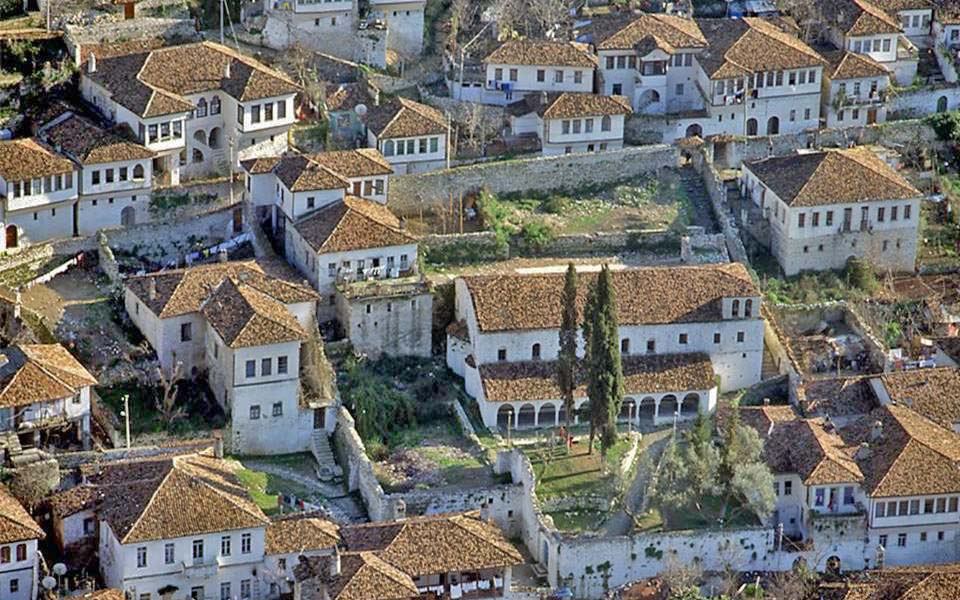
The road to the north from here is well developed and crosses one of the most scenic sections of Albania. Wide, untamed river valleys with weathered bridges and an impressive mountain backdrop evoke memories of Karl May's novel "Through the Kingdom of Skipetars". Soon Berat is reached, one of the oldest cities in Albania. The castle district on a hill consists of numerous houses, most are still inhabited, as a UNESCO World Heritage Site, they are under special protection. A former cathedral is used as a museum. Impressive is the precious icon wall with scenes from the life of Jesus and the twelve apostles and saints. Below the castle is the district Mangalem, also called "city of a thousand windows", with mosques and fascinating old houses.
Photo: /Manfred Ruthner

Kruja

High on a steep mountain slope lies the city of Kruja, which is inextricably linked to the history of Albania. From here, the Albanian national hero Skanderbeg led a successful fight against the Turkish army. In the castle, the very turbulent history of Albania is graphically traced. When you look from the top, you can already see the suburbs of Tirana, the final destination. On entering the capital, you can still see depressing prefabricated buildings, relics from the communist era. But the center presents itself as metropolitan, with a broad boulevard that runs between government buildings in Mussolini architecture and well-kept parks and finally flows into the Skanderbeg Square with opera and cultural palace from the 1960s.

Read original article: https://kurier.at/reise/auf-entdeckungsreise-durch-albanien/308.080.481 

05 December 2017

Albania among best trips 2018 by National Geographic

Albania is listed among 21 places to be visited in 2018 by the most prestigious media National Geographic. This is great news for our country. But the most important thing is that we are listed for such an extraordinary underwater world, which is still unexplored and unknown even for Albanians themselves. This is a call  for all people who love to dive and explore the underwater world. It is the only country among other 21 placed in the list, to be suggested by National Geographic for such a special underwater tour. Here is what the article says about Albania:


“Sunken aqueducts, shipwrecks, and rarely visited caves are a few of the relatively untouched treasures awaiting divers in Albania. Decades of isolation under communist leader Enver Hoxha limited development and inadvertently preserved underwater cultural heritage, particularly off the southern coast.”
You may ask why scuba diving wasn’t famous in Albania, because the dictator Hoxha banned scuba diving to prevent Albanians from escaping.


24 November 2017

Telegraph: Albania- Europe's next big beach holiday destination?!

“Albania is like a missing piece in an otherwise completed jigsaw - the final portion of the landmass along the Adriatic which has not become a beach-holiday stalwart”. This is how Telegraph, the UK multimedia news brand describes our country, Albania. This media promoted Albania as a travel destination in several articles and this one is written by the author Chris Leadbeater, who sees Albania as a unique destination different from neighbor countries such as Greece, Montenegro and Croatia.
Ksamil Beach, Credit © 2011 Azem Ramadani 
“But if you take another glance at the map, one remaining pocket of the relatively unknown may just stare back at you. Albania is like a missing piece in an otherwise completed jigsaw - the final portion of the landmass along the Adriatic which has not become a beach-holiday stalwart” writes Telegraph.
Albania, by contrast, is still almost unheard of as a package destination - despite the fact that its 265 miles of seaside are in a prime location. In a rare event, the country can claim to be lapped by not just one sea, but two - the Adriatic and the Ionian are deemed to meet in the sheltered Vlorë Bay (where Vlorë, the country's third largest city sits). That, at this point, the distance between Albania and elbow of Puglia, away to the west in Italy, is just 60 miles, only emphasizes the splendor of this Balkan country's location.
There should be a caveat here, of course. To say that Albania is almost unheard of as a package destination is to overlook the many Albanian tourists who are well aware of their home state's suitability for a week on the sand. There are plenty of rooms, and plenty of paying customers, in the hotel zones of Durrës (the second city, in the north of the country) and Saranda (the key tourism hotspot, in the south, close to the Greek border). It is just that, as yet, there are very few Britons among them. The cat remains in the bag.
Photo source: Telegraph
Albania is already an intriguing country to visit - Tirana is an increasingly cosmopolitan city, while the country's wealth of ancient archaeological sites (including the likes of Apollonia and Butrint) might almost rival Italy. But in a time when question marks linger over traditional beach destinations such as Egypt and Turkey, it could be that, in the next three or four years, its main appeal will be as a place in the sun. Mystery solved.

See full article here!

26 October 2017

National Geographic: Albanie, la plus belle destination pour 2018

Le magazine National Geographic fr, publie les 14 plus belles destinations pour 2018. Parmi elles, l'Albanie..

11. PARTIR À L'AVENTURE EN ALBANIE

Dictature communiste durant des décennies, l’Albanie s’ouvre doucement. Découvrez ses villes ottomanes (Berat et Gjirokastra), ses amphithéâtres gréco-romains, ses plages… et, surtout, sa nature inexplorée : sommets alpins, vallées verdoyantes et zones humides à la faune riche. Pourquoi maintenant? Circuit à pied ou à cheval, trek, rafting, kayak… L’Albanie joue à fond la carte de l’aventure. Dernière initiative en date: en mai dernier, un chemin de randonnée a été ouvert dans la réserve naturelle de la péninsule de Karaburun, une ancienne base militaire accessible seulement à pied ou en bateau. On traverse la presqu’île en partant d’une petite baie propice à la plongée sous-marine, et on termine en découvrant une vaste grotte de 600 m2.

Cliquez ici:


Start now your adventure in Albania!

Albania, a communist dictatorship for decades, slowly opens for tourists. Discover its Ottoman cities (Berat and Gjirokastra), its Greco-Roman amphitheatres, its beaches ... and, above all, its unexplored nature: alpine summits, green valleys and wetlands with rich fauna. 
Why now? Circuit on foot or on horseback, trek, rafting, kayak ... Albania plays thoroughly the map of the adventure. Last initiative: Last May, a hiking trail was opened in the Karaburun Peninsula Nature Reserve, a former military base accessible only by boat. We cross the peninsula from a small bay suitable for scuba diving, and we end by discovering a large cave of 600 m2.


28 September 2017

The Guardian picks Albania’s seaside for the gallery of the week

The  well-known newspaper Guardian chooses once a week the best gallery with photos of  a destination. This time, it was Albania. Jure Matičič the winning photographer of the week captures the Albanian seaside town of Durrës.  Matičič is a photographer from Ljubljana, Slovenia, and recently visited Durrës, Albania’s second largest city.

Photo credits: Jure Matičič 


Along the seafront, kids were playing on a statue commemorating Albanian resistance to the invasion by Mussolini’s Italian forces on 7 April 1939.


Photo credits: Jure Matičič 

About 35km west of Tirana, Durrës is a port and among the largest cities on the Adriatic. It’s also a popular seaside resort. For decades, under the communist regime of Enver Hoxha, it was just about the only holiday destination available to Albanians.


Photo credits: Jure Matičič 


The city was, briefly, renamed Durrës-Enver Hoxha during the late 80s. Then (after the fall of communism) it became the location for mass migrations to Italy. In the past couple of decades, Durrës has had a facelift.


13 July 2017

Swap Costa Brava for the turquoise waters of Ksamil, Albanian Riviera

The Culture Trip, one of the most popular travel guides in the world, has listed the beach of Ksamil in Albania on 3rd place among 8 cheaper summer destinations in Europe.  Culture Trip recommends that everyone should go on vacation in the Albanian Riviera, while compares Ksamil beach with Costa Brava in Spain, with the only difference that Albania is much cheaper.
Ksamil, Albanian Riviera | © Cannm01/WikiCommons

“When choosing the perfect beach for your summer vacation, the color of the water counts! The more turquoise, the better. Saying so, it is quite surprising that Albania hasn’t fallen into the spotlight, with its Caribbean-colored water and rugged cliffs along the coastline. Ksamil is among the favorite seaside resorts for both locals and foreigners.”

See full article here !

19 January 2017

Albania among Top Budget Destination for 2017 by Rough Guides

Rough Guide is a worldwide travel guide for more than 120 destinations and Albania is one of the destinations recently promoted on the their “Top Budget Destination for 2017” list. The Albanian coast is becoming very ‘famous’ and everyone who visits Albania shouldn’t miss exploring our beaches. Rough Guides put Albanian coast among top budged destinations, part of this list are popular destinations such as: Detroit (USA), Mexico, Greece, Cambodia, The Philippines etc.
Check out what Rough Guide says about Albania:


Albania retains one of the last unspoiled coastlines in the Mediterranean. Sun-drenched mountains and white-sand beaches spill into the bright blue waters of the Adriatic Sea, while Ancient Greek ruins and historic Ottoman villages punctuate the surrounding rural landscape.
You’ll find none of the usual high-rise resorts, crowded shores and high prices typical in the rest of the Med here, with fresh seafood, quality bars and comfortable accommodation available at a fraction of the cost.
And with more affordable flights due to connect Tirana with the rest of the continent in 2017, Albania is set to be even more accessible for travelers on a budget.


12 July 2016

Business Insider: There is no better time to visit Albania than now

Locked between dramatic mountain faces and azure blue seas; it’s nothing short of a miracle that Albania hasn’t made it onto the mainstream tourist trail yet.
Shqipëria” to the locals, it’s known to its natives as the land of the eagles, a moniker adopted from folklore tales passed down from generation to generation. They tell of how a young Albanian saved an eaglet from certain death at the fangs of a venomous snake. And it’s that willingness to do things for others that sums up the spirit of the country.
Albanians are known for their hospitality, kindness, and affinity for knocking back glasses of homemade Raki. The days of communist dictatorship are a distant memory for all but a few. Albania is looking ahead to a brighter future. There is no better time to visit than now. 
The author of article, the blogger Tiny Rucksack suggest 5 places in Albania that everyone should visit. Here they are:
                                BERAT
Tucked between the Tomorr mountain (which locals claim to be the resting body of a fallen giant) and the Osum river, Berat is the jewel in the crown of Albania. Home to 60,000 people, many of whom tell tales of being forced to work in the munitions tunnels carved by the Communist government into nearby hills. It’s a town of two halves – the winding medieval white-washed streets cut a course on the right bank of the river, while an altogether more modern settlement is the hub of the town on the left bank.
High above the town lies its castle – a fortress built to protect the town and her inhabitants from Byzantine raiders. Once it was a front line of wars between powerful empires vying for control. Now a slippery marble paved road keeps all but the most determined flip-flop clad tourists from reaching the top.Consecutive invasions of Berat have left the town with a mixture of architecture. The Turks brought their influence, as did the Communists. An interesting mish-mash of styles pleasing to the eye, and the camera.

                    Valbona National Park
Misty mountains and alpine streams dominate in this untouched corner of europe’s unexplored country. The traditional way of life is slowly changing in the steep-sided valleys. Farmers are turning their hand to hosting trekkers looking for adventure.
The region borders Kosovo, territory fiercely claimed by both Serbs and ethnic Albanians. It’s home to wild dog,  wolves, and some say bears. But don’t let this put you off. The mountains offer fantastic trekking, climbing and camping.

Albania is becoming a stoic pinpoint on the map for travellers from around the globe. New roads are being built, hotels are under construction, and the country is planning to build a second airport, at Kukës – development which’ll make getting to northern Albania much easier, and visiting a more attractive prospect.

                The “not to be missed” Lake Koman ferry
A ride along Lake Koman is only comparable to a trip on the Norwegian fjords. Bottle green trees meet the waters edge along the breathtaking route.  The landlocked lake through the ‘accursed mountains’ is actually a hydro-electric damn, but also forms part of an ancient route from Kosovo to Albania. The rickety ferry stutters into life several times a day, passing which scenery has to be seen to be believed.
photographers dream, the landscape could have been plucked from the Lord of the Rings trilogy. Mountains tower above the lake as it weaves its way to Fierza. It’s a route used by tourists and locals alike – meaning it’s a great chance to practice pigeon Albanian (or sit back, have a beer and take in the views). 
Lake Koman is the most scenic route to travel to the Valbona National Park from Shkodër. It has been described as “one of the world’s great boat trips”.

                                              Himarë
This sleepy fishing village on facing out toward the Ionian Sea remains relatively untouched by Aussie backpackers flaunting flip-flops and tales of far-flung lands. Sea food restaurants line the sea front enjoying unspoilt views over the town’s beach.
 Less than half an hour’s stroll away from the Xhiro is ‘Albania’s Ibiza’ – Jala. Toned men and bikini-clad women descend on the beach to drink at its bars, swim in crystal clear waters and ‘be seen’ during the summer month. It’s a world away from the serenity of the surrounding villages.
Reminders of Albania’s communist dictatorship past are ever present.  On a clear day the Greek island of Corfu is visible – too visible for those once in Tirana’s corridors of power awaiting an imminent invasion which never came. The now defunct fortifications line the roads leading between the coastal towns and villages.

                                         Tirana – the capital city
Probably Europe’s weirdest capital city. At first glance Tirana doesn’t have a huge amount to offer a wondering soul, but its quirkiness makes it worth at least a day stop-off. The International Center of Culture (or the Pyramid of Tirana) tops the Albania’s list of the weird and wonderful. Opened in October 1988 was intended to be a museum to Enver Hoxha – the leader of Albania’s communist cult. The pyramid new sits empty and derelict. It’s an ad hoc climbing frame for plucky locals and tourists hoping to get that “perfect selfie”.
Tirana of the centre of Albanian life. Smartly dressed men and women weave their way between the chaotic traffic like in any other European capital. It’s the home of the country’s night life, especially the Blokku area, a section of town formerly reserved for the country’s elite.


Read article here: 

23 June 2016

Albania - 1,000 windows and invaluable cultural assets

Long underrated and finally recognized - Albania is one of the most beautiful travel destinations in south-eastern Europe. A wild and romantic natural landscape, countless ancient cultural sites and the touch of the Mediterranean climate make the country at the Adriatic Sea increasingly popular.

Geography - 300 sunny days in Albania
The idyllic country of Albania lies on the Balkan Peninsula between Montenegro and Kosovo, Macedonia and Greece. In addition, the south-eastern European country is enclosed by the Adriatic and the Ionian Sea. It is divided into twelve qarks (prefectures) and the capital of Tirana. Besides Tirana, popular travel destinations are Sarandë at the Ionian Sea as well as Vlorë and Durrës at the Adriatic coast. Albania prides itself on having no less than 300 sunny days per year. The climate is warm and it only gets colder in winter. July is the warmest month with an average temperature of 24 °C.

Nature - Wild beauty
From the sea to the high peaks of the mountains, Albania fascinates with wild natural beauty. Untouched sandy and pebble beaches at the coast, which is 362 km long, secret lagoons, juicy valleys and the fertile hilly landscape extend in front of the panorama of the breathtaking Albanian Alps. Most travellers are overwhelmed by the unspoiled and diverse variety of landscapes. The country is still an insider tip and surprises many holidaymakers. With regard to natural diversity alone, Albania has a lot to offer. It lies in the center of the Blue Heart of Europe and has a great share in the European Green Belt. You see palms, orange trees, almond trees, laurels, pines and olive trees between the oak forests, which create the country's Mediterranean charm. The forests are home to wolves, lynxes, deer and kites and you can watch loggerhead sea turtles at the coasts. Furthermore, countless migrating birds come to the island every year. Besides the attractive coast, the deep blue mountain lakes and the vast river landscape, Albania impresses with its Alpine landscape. Its highest peak is Mount Korab with a height of 2,764 metres.

Natural sights - Secret beaches and untouched national parks

One of Albania's greatest attractions is without doubt the Albanian Riviera. This harsh but magical cliff coast, which is waiting to be discovered, is located at the coast of the Adriatic Sea. Numerous holidaymakers visit the wonderful beaches at the Adriatic Sea and enjoy the crystal clear water, especially in the warm summer months. Despite this, the beach sections are not overcrowded and you will easily find a cosy spot to have to yourself. Nevertheless, the coastal towns have adjusted to tourism and offer everything travellers could desire. There are over a dozen spectacular national parks, some of which have hardly been developed. In the Theth National Park in the far north, visitors can explore the steep mountains and the Grunas Waterfall along exciting hiking routes.

Culture - A top travel destination catches up
Albania's history dates back to the Illyrians. For a long time, the region was part of the Ottoman Empire. Many inhabitants of Albania are Muslims to the present day and you see Muslim buildings and mosques all over the country. Albania is generally rich in history with many traditions and a wide range of cultural sites and activities, which is becoming increasingly interesting for tourists. The latter is a rather new development. Albania only gained the possibility to develop with regard to many areas including tourism after the Communist regime had been brought down in 1990. Up to that point, the country was nearly inaccessible to visitors. Albania's efforts to catch up in this sector soon proved fruitful and the number of people who visit the attractive travel destination increases every year. It was recently added to the top list of the best travel destinations worldwide by the New York Times. Travellers especially value its numerous ancient buildings, the incredibly wild and romantic nature and the charming inhabitants.


Cultural sights - 1,000 windows and invaluable cultural assets
The colourful capital of Tirana is only 30 kilometres away from the sea and offers a variety of appealing sights. Travellers particularly enjoy the coastal towns. The placid city of Vlorë is a popular bathing resort in summer and impresses with its wonderful Kaninë Castle. The Mediterranean bathing resorts of Sarandë is equally popular. Due to its countless small alleys and winding paths, the city of Korçë is also called the "Paris of Albania". Other impressive sights are the ruins of the ancient city of Apollonia, which had over 60,000 inhabitants during its time of prosperity. Near the seaport city of Durrës, you see the ruin of an ancient amphitheatre. The ruins of Butrint and the "Town of a Thousand Windows", Berat, have been declared UNESCO World Cultural Heritage sites. Berat is a Balkan-Ottoman town with a magnificent medieval castle and is frequently visited. The same is true of the medieval Krujë Castle in the city of the same name and the Skanderberg Museum. Travellers who are interested in Venetian architecture should not miss out on Shkodër's old town.

Experience - Between medieval villages and party nights
Albania's Mediterranean Balkan cuisine displays influences from Turkey, Greece and Italy. Fish and chicken are popular. Some of the most common dishes are byrek, biftek and lokum. The national drink is rakı. The latter is mostly drunk in the evening hours, when Albania's nightlife starts. Tirana and the well-known coastal towns are vibrant with activity every night. Locals and travelers populate the streets at night in a cheerful and social mood. In some places, roads are closed to car traffic, so that passengers can walk from bar to bar, into the next trendy restaurant or the latest night club. The venues are often opened until the early morning hours and make long party nights possible. During the day, visitors can go for a stroll along the wide boulevards and buy one or two reasonably priced souvenirs. If you do not find anything there, you should visit the bazaar in Krujë. Relaxation is offered by the Turkish bath, which is also located in Krujë.

Activities - Conqueror of the mountains
Climbing and mountaineering in the Albanian Alps is still a real adventure. Some peaks have never been climbed before and are waiting to be conquered. Travelers who want to explore Albania in a more relaxed way can experience the country's natural beauty along scenic hiking routes. Since the tourism sector is only starting to develop in many areas, travelers are often on their own when it comes to organizing their leisure time. One exception is rafting in the Osumi River canyon. Exciting tours are being offered from March to June. In addition, holidaymakers can explore Albania in a cross country vehicle and visit the neighboring countries. The Greek island of Corfu, for example, is located at the most narrow point of the Ionian Sea and is only two kilometres away from Albania.

Information
Travellers reach Albania by plane or car. In addition, there is a ferry which travels from Italy to Albania. Arriving by train is not possible at the moment. Within the country, you best use the bus network. If you want to drive yourself, you should note that the roads are in a very bad condition in several parts of the country.
Slowly but surely Albania is developing into one of the most beautiful travel destinations in Eastern Europe. Its untouched nature, the wonderful, varied cities and the friendliness of the inhabitants make Albania increasingly popular in the world of travel.


13 June 2016

National Geographic: Why to go in Albania

Over the past years Albania is attracting the attention to worldwide known travel magazines and media. This time the National Geographic has listed Albania among 10 Places that deserve more travelers. Firstly they describe the situation on the ground. “For decades, Albania was among southeastern Europe’s least visited—and least accessible—countries. A virtual fortress under the isolationist tactics of communist dictator Enver Hoxha (who spent four decades building over 700,000 needless, and largely useless, defensive bunkers across the country), Albania collapsed into chaos after Hoxha’s death in 1985 and the subsequent fall of the U.S.S.R”.

And after that they present Albania how it is today, Albania is no less safe than its more well-trodden Adriatic counterparts. A burgeoning tourist industry—centered around its meticulously preserved UNESCO-listed Ottoman towns, including Berat and Gjirokastra, and the stretch of land now known somewhat archly as the Albanian Riviera
Butrint
, —now brings in almost 3.5 million tourists a year. This article reveals Albania how it really is and the reason why go now.

Why Go Now: While Adriatic beaches in nearby Italy and Croatia have largely been transformed into crowded, hypermodern resort complexes, Albania’s coastal beaches, dotted with ruined Greco-Roman amphitheaters and whitewashed, icon-filled Orthodox churches, are among the few in Europe where it’s possible to stretch out on the shoreline, even during high season. South of Vlorë, the somewhat concrete-feeling coastal hub, ethnically Greek villages like Dhërmi, Vuno, and Himarë—with terrace cafés, waterside squid-hawking fishmongers, and narrow pedestrianized pathways—are inundated with family-run B&Bs that go for as little as $25 a night. Travelers from outside the Balkans are still rare but vigorously welcomed. Don’t be surprised if your B&B host insists on taking you on a dizzying motorcycle tour along the coastline or challenges you to a staggering rakia-drinking competition.

National Geographic has listed which places you shouldn’t miss in Albania, such as: Butrint, the city of Saranda, Byzantine basilicas, and Roman mosaics etc.

See full article: http://www.nationalgeographic.com/travel/features/ten-places-that-deserve-more-travelers/