Showing posts with label Albanian bunkers. Show all posts

06 July 2016

Exploring ancestral lands- fascinating Albania


"Traveling in the ancestral lands of Alexander the Great, I recently explored the unique sights found in the Balkan countries of Macedonia, Albania and northern Greece.
The three Balkan countries I visited preserve a tremendous amount of antiquity and ancient history, as they all have very rich heritages..

Our journey from Greece took us across the border to fascinating Albania, which was the most isolated and closed country in the world following World War II.
Its brutal Communist dictator had closed its borders, and his irrational fear of an invasion led him to construct an unbelievable number of 700,000 small bunkers, plus tunnels, to allegedly protect his population. I have never seen such a weird sight as these bunkers still lining the highways and its cities.

Stunning Ottoman-style homes, ancient fortifications
In Albania, we spent two evenings in the UNESCO world heritage city of Gjirokaster, a very old historic town on a steep hillside containing several Ottoman-era mansions with stone slate roofs and crowned by a massive 15th century castle.
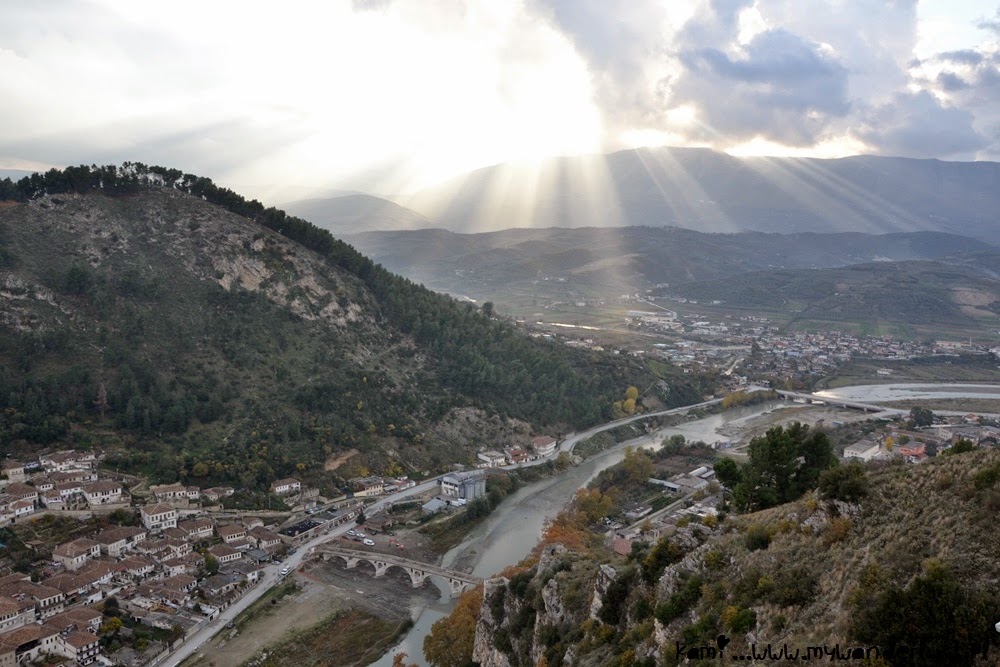
We visited its Ottoman bazaar dating from the 17th century. Later we toured the town of Berat, containing stunning Ottoman-style homes and a 2,500 year old fortification.

Tirana, Albania's capital, was our next destination. It is a fairly modern city with wide boulevards, parks and high rises.
Here we learned about the turbulent history of the country that included 400 years of occupation by the Ottomans, Italians and Nazi's during WW II, and the 45 years of a Communist dictatorship."


 "Exploring ancestral lands", is an article published in Sun Times by Dave Pattison also known as “The Marco Traveler". The author choose these 3 places Albania, Greece and Macedonia to write about in his last article for the Sun Times."This is my last article I will write for the Sun Times, which is ceasing publication, and I hope readers have enjoyed learning about places known and unknown, and have gained an understanding about unique and varied cultures that can be discovered around the world", he wrote.


Read full article:


02 April 2015

Open for adventure


"As a visitor, one wonders how Albania, - a European country with such beautiful sea coast and of course bathing water, so high mountains to hike in and with so many well-preserved historical sites to marvel at, has taken over 20 years to appear on the international tourist map. Anyway, this fact is today probably Albania's greatest asset as a tourist destination. Capital Tirana is a colorful acquaintance with many popular restaurants and hip cafes, fine parks and inspiring pulse. Albania is mountainous. Adventure tourism is in its infancy but something that is invested vigorously. Already arranged both rafting and kayaking, wreck diving and hiking in the dramatic surroundings".

This is how a Swedish Journalist, Kicki Lind describes Albania. This article recommending Albania as a very attractive tourist destination was published in three newspapers in Sweden. Here is a summary of this article:

**
Open for adventure
by Kicki Lind

How could it have taken over twenty years for a country that holds so much to see appear on the international tourist map?... Times have changed. Albania is nowadays an open country, and many of the people who fled Albania during the Stalin-inspired dictatorial regime has returned... There was a time when Albania was standing alone against the rest of the world. The dictator Enver Hoxha had in the 1940s, 50s and 60s chummy contacts with both Tito and Mao as Moscow, but broke in turn these into a confidence that Albania could be attacked from both East and West... The bunkers vary in size and remains a prominent feature on the Albanian countryside. Some smaller bunkers are now used for everything from mushroom cultivation to cabanas while others razed to the ground so that building materials can be reused. Hoxha's own bunker on 2685 square meters just outside Tirana was among the larger and was until recently with the military's list of secret items. Most Albanian bunkers are a few square meters while Hoxha's bunkers holds 106 rooms and a cinema. It has now been opened to the public.... The world is notoriously full of places where cruel story turned into tourist attraction. In Albania stands island of Sazan, an hour's boat ride outside the coastal city of Vlora, in line to be such a place. ... the island since Roman times been used as a military base... now there is a hope that Sazan to have become an interesting historical and cultural outdoor museum of the Cold War.
... And certainly, as a tourist country, Albania is cheap, the price level is probably the lowest in Europe. But let us hope that the increasing amount of visitors interested in more than sunbathing and swimming, the Albanians themselves are able to take care of its magnificent scenery and the dignity manages to preserve at least some of their ancient traditions...

A few mil outside Sarandra is the National Park and World Heritage Butrint, a large and very evocative archaeological site with more than 3000 years old. Butrint has been both Greek colony and Roman city and it hardly needs to be especially historically literate to be seized by the powerful atmosphere that fits in the amphitheater, among the pillars and portals, and in the old swimming pool surrounded by lush greenery and salty sea breezes. It is orderly and exciting without even one souvenir salesman in sight.... Another few miles from there, up in the mountains inland, lies the village Pilur whose little more than a hundred residents seem to take a rather sleepy existence. It is precisely in Pilur as Albanian polyphony, an old song tradition that is characterized by multiple melody parts simultaneously, is said to have originated and villagers actively tradition. The polyphonic singing has been given by Unesco World Heritage status as "a masterpiece of humanity's oral and intangible cultural heritage...
As a visitor, one wonders how it is that a European country with such beautiful sea coast and of course bathing water, so high mountains to hike in and with so many well-preserved historical sites to marvel at, has taken over 20 years to appear on the international tourist map. Anyway, this fact is today probably Albania's greatest asset as a tourist destination.

Capital Tirana is a colorful acquaintance with many popular restaurants and hip cafes, fine parks and inspiring pulse. Heavy gray statues reminiscent of another time is now almost piquant feature of the cityscape that is characterized by hilarious lively venues where språkas, drinking cappuccino, latte, macchiato and domestic brew raki from early morning to late evening. Unemployment remains high and income disparities great but the younger generation in Albania face the future with confidence. The express speed.

Albania is mountainous. Adventure tourism is in its infancy but something that is invested vigorously. Already arranged both rafting and kayaking, wreck diving and hiking in the dramatic surroundings.


Full article:

http://www.sydsvenskan.se/resor/oppet-for-aventyr/

25 February 2015

Impressions from Albania

Albania is continually  impressing tourists coming from all over the world, especially those who come for the first time. A Polish tourist is describing our country with such heartfelt words. She is amazed by the beauty of Albania: landscape, towns, people and food. Thank you Kami.
Enjoy her article!

Impressions from Albania
By Kami and the rest of the world

"Albania is the country I knew next to nothing about prior to my visit. I have included Albania in the itinerary, even if just for two days. And it was the best decision ever! From the very first moment I opened my eyes in the bus somewhere in the middle of Albania I knew I’m going to enjoy it. It looked messy, chaotic and so beautiful! .. Dramatic mountains, deep valleys and picturesque towns – that’s what I’ve seen in Albania.. Albania joined the club and ranks pretty high in my personal list of the countries with best people...  It’s been locked for years, making it almost impossible to learn more about it but fortunately it’s slowly opening to the world. The tourism is growing, Albania is discovered by more people and I’m sure in few years’ time it will be a really big thing! So make sure to get there before everyone else will! ....."

Read the full article here:
http://www.mywanderlust.pl/impressions-from-albania/


24 November 2014

Albania Opens Five-Storey Secret Bunker Built by Communists

A great attraction is added to Tirana, the capital of Albania. Visitors, but also Albanian themselves will be surprised to find out what was underneath the communism regime they lived and suffered. 
Work on the bunker, 100m (330ft) underground, was completed in 1978 but it was never used
A large secret bunker that Albania's communist regime built in the 1970s to survive a nuclear bomb has been opened to the public for the first time.
Then dictator Enver Hoxha wanted the bunker near the capital Tirana to guard against Soviet Union or US attacks.

Prime Minister Edi Rama showed several Western ambassadors around the 106-room, five-storey complex on Saturday.

"We have opened today a thesaurus of the collective memory that presents thousands of pieces of the sad events and life under communism," Mr Rama said in a speech in the bunker's 200-seat hall.
Hoxha's regime built up to 700,000 bunkers before he died in 1985. The communist regime was toppled in 1990.

How to get to Bunkart Museum: From Tirana International Hotel in the center of the capital take the bus with the logo of Bunkart. This service is free of charge for
Bunkart Opening hours: Everyday 9.00-16.00
Bunkart  Entry tickets: free of charge November -December 2014

Map of Bunkart  in Tirana

shqiptarja.com
If you need any help arranging your trip to Tirana, Albania email us at: contact@albania-holidays.com

04 June 2013

Tourism in Albania: a building site with potential

Our country Albania is now featuring in Swiss media as potential tourism destination. A very realistic article about Albanian tourism highlighting advantages and disadvantages- "With its stunning coast, its history, its ancient ruins, his mountains and its unspoiled nature mean that it has a lot of potential but also a bad reputation is associated with corruption, criminality and blood feuds ".
Enjoy

Gaby Ochsenbein in Tirana, swissinfo.ch
June 3, 2013 - 11:00
Image Caption:
May 2013 in Vlora: a seaside holiday awaits (swissinfo)Albania, sealed off for decades, and only open to visitors for the last 20 years, is trying to promote itself as a tourist destination. But it is not well known, and is by no means a tourist hotspot, even if visitor numbers are climbing.
May 2013 in Vlora: a seaside holiday awaits
"Albania is not yet on the radar, but with its stunning coast, its history, its ancient ruins, his mountains and its unspoiled nature mean that it has a lot of potential,“ says Alexander Wittwer, since January 2013 the Swiss ambassador in Tirana.

Albania may have potential, but it also has a bad reputation: it is associated with corruption, criminality and blood feuds. No wonder that for the moment it doesn’t feature among the holiday destinations offered by the two big Swiss travel agents Kuoni and Hotelplan.

When asked why, they say there is little demand. Most visitors go on special hiking, cultural or educational tours. Nevertheless, the number of Swiss visiting Albania has risen from about 6,000 in 2005 to more than 40,000 last year.

The biggest rise in visitors are those from its neighbours, Kosovo, Macedonia and Montenegro. But tourists from Greece, Italy, Germany, Poland and other countries can also be seen, usually in tour groups. Occasionally a cruise liner anchors on the Albanian Riviera. But individual travellers are few and far between, even if the Lonely Planet guidebook company named Albania as a top tourist destination in 2011.

Foreign Visitors to Albania

Country/2005/2012

Switzerland: 6150/42,546
Kosovo: 336,322/1,708,743
Macedonia: 141,160/399,281
Greece: 47,776/225,175
Montenegro: 105,636/186,536
Italy: 62,520/147,018
Britain: 33,163/78,593
Germany: 23,391/70,060
US: 30,108/58,621
France: 9984/30,128
Austria: 6230/22,562

Dangerous potholes and kind people

Anyone wanting to explore the country by public transport needs their share of patience, but learns a lot about the way people live. There are few railway lines and the trains are very slow. There is quite an extensive bus and minibus network, but timetables are not always available. And car drivers are faced with bumpy roads full of potholes, especially on the cross-country routes. Even the pavements are full of lurking dangers: open gullies and unprotected building sites await the unwary pedestrian.

But such problems are quickly forgotten in the face of the kind, helpful and curious people, who are happy to talk to foreign visitors. You meet herdsmen with their cows, sheep or goats, fishermen auctioning their catch at the edge of the road, elderly people ploughing by hand, or leading their mules or donkeys laden with wood, straw and much else. Food is good and cheap, hotels as a rule clean and inexpensive, and the rivers and mountains are magical.  

Bunkering down

Reminders of the Cold War


In Albania they are impossible to miss or ignore: the bunkers from the time of the dictator Enver Hoxha. They can be seen in towns and villages, in gardens and vineyards, in the hills, in the mountains, by the sea - and even in cemeteries.

Mercedes and concrete

Something that strikes every new visitor to Albania is the large number of Mercedes, which are omnipresent in the towns and villages. It is impossible not to wonder who can afford such an expensive car in one of the poorest countries of Europe, and how many of them are perhaps stolen. It’s as if people have an immense urge to catch up – in the forty years of the old regime under Enver Hoxha all private transport was forbidden.

Something else that is impossible to miss are the concrete bunkers of various sizes, which the regime put up all over the country in the 1970s and 80s for fear of invaders. These relicts of the Cold War can be found on beaches, in the mountains or among houses – there are said to have been a hundred thousand of them in all.

There’s plenty of concrete being used today: Albania looks like one huge building site. Roads and motorways are being constructed everywhere, while houses are shooting up along the coast and in the cities. But not all of them get completed, whether because the money runs out, or because the illegal work is halted by the government. The result is that the countryside is disfigured by countless ugly shells of buildings.

The natural surroundings are also spoiled by rubbish dumped in picturesque spots: plastic bags and trash of all sorts is to be found by rivers, in fields, at the back of houses. And when the wind is in the wrong direction, the stink coming from burning rubbish dumps forces the guest to close his hotel window.

Switzerland-Albania

The two countries have had diplomatic relations since 1921. Switzerland has had a head of mission in Tirana since 1991.

The State Secretariat for Economic Affairs (Seco) and the Swiss Agency for Development and Cooperation (SDC) have an annual budget of about CHF13 million ($13.6 million) for their programmes in Albania.

Economic relations are at a low level: Swiss exports to Albania in 2011 were worth CHF36 million, and imports CHF3 million.

There are 69 Swiss nationals registered in Albania. Some 200,000 Albanians from Kosovo live in Switzerland, but only about 1,000 from Albania.

A business under construction

The Albanian tourism agency is also still in the process of construction, as government spokesman Enton Derraj admits. For two years he was an advisor at the ministry of tourism.

"Our biggest problem is waste management. All foreigners mention this. We are working on our waste disposal system and every year we conduct anti-litter campaigns. Basically, it’s not to do with the system or the infrastructure, but with mentalities. It will take time to raise people’s awareness of the issue."

To promote itself as a tourist destination, over the past few years the country has been investing in building and improving the infrastructure in tourist areas: road building, water supply, health. In some cases it has received help from abroad.

Two years ago a law on spatial planning was passed, aimed at preventing illegal building such as had taken place on a grand scale in coastal cities like Saranda, Durres and Vlora. Major projects like holiday resorts must now get the approval of the national planning commission.

"We want to avoid seeing the entire coast built up, in the way that happened in Montenegro, for example."

No mass tourism

Derraj maintains that Albania is not looking for mass tourism.

“It’s true that we want to develop beach tourism, but not like in Spain or Greece, but bearing environmental considerations in mind," he said.

The new strategy, due to be approved this year, will promote hiking, mountain tourism and agrotourism, and also cultural tours. Albania has three Unesco World Heritage sites: the ruins at Butrint and the Ottoman cities of Gjirokaster and Berat.

It has only been possible for outsiders to travel freely to Albania for the last 20 years. That means that foreign tourism and the hotel industry are relatively recent branches of the economy, and the country lacks experience in the area, Derraj says. It has not collected tourism statistics, only entries and exits, with no way of knowing whether the visitors are tourists or businesspeople.

Nor are there any statistics about hotel overnights.

“For tax reasons hotels are unwilling to cooperate with the data collection system of the tourism ministry,” he explains. “Since they still need to invest and grow, we aren’t putting any pressure on them at the moment. We are fairly tolerant."

http://www.swissinfo.ch/eng/politics/Tourism_in_Albania:_a_building_site_with_potential.html?link=tdj&cid=36008586

06 May 2013

Albanian Beauty & its 700,000 Bunkers: Profiling a Man Who Built Them

Thank you Tricia for the nice and emotional article and the wonderful look inside everyday life in our beautiful country Albania!


Albanian Beauty & its 700,000 Bunkers: Profiling a Man Who Built Them


As our minibus chugged through the Albanian countryside during our 6-hour trip, my husband and I inadvertently created a new car ‘game’ to pass the time: who could first spy a bunker as a new one appeared in the ever-changing panorama?
With nearly 700,000 bunkers still dotting the southeast European nation’s landscape even today, the game didn’t prove challenging. We saw a man leading a donkey past a mammoth-sized bunker, and then small ones clustered at the tops of hills, plus another pair nestled beside a home.......
bunker in albanian countryside
Just one of 700,000 + bunkers scattered across the Albanian landscape.
 
Read full article here:
Also in this article don’t miss Shawn’s video below,