Showing posts with label Albanian history. Show all posts

12 February 2018

Albania reborn: What to see and do in Europe’s newest holiday hotspot- Daily Express

“So rich in treasures and sensational sights, everyone has wanted a piece of Albania over the centuries. Maisha Frost discovers a mysterious beauty coming out of the shadows and longing to welcome the world.” This is how the renowned British media “Daily Express” describes Albania in a long article.
Every first time visitor in Albania is impressed by so many things that you can find attractive and worth a visit in this forgotten corner of Europe.
Kruja citadel: Getty Images

“Ancient Greeks, then jeweler-loving Illyrians, the ancestors of many of today’s Albanians, were followed by Romans, Byzantines and Ottomans who all seized, settled and surrendered here in a relentless game of thrones.
Today’s democratic Albania is transforming fast in other ways: the power blackouts and potholes are in retreat and the young as stylish as their European counterparts. Few too would have predicted the land’s dividend from a failed state that never saw through its plans for collective farms. Albania’s small family-run farms stayed largely pesticide-free and its wildernesses untouched.  Today that means organic havens for produce and wildlife, a place for taste delighting foodies and ramblers, with lots for the locals to shout about.
What to see in Albania:
Tirana - Capital of many colours
The capital Tirana is lively and safe, but with an understated, surreal side that often leaves visitors wondering what to make of it.
Part Mediterranean town, part Soviet relic its rainbow-coloured apartment blocks, painted on the orders of a former mayor to bring some cheer, are more faded pastel these days.
For good reason perhaps Tirana’s citizens seem to have a Pythonesque talent for looking on the bright side of life. Ask them about Albania’s reputation as a gangster factory and they promise – only half joking - “there’s no trouble here, we’ve exported all the criminals”.
The city’s cultural highlights include a triumphalist history mural guarding the entrance to the classical artefact-packed national museum and the pretty 18th century Et’hem Bey mosque’s minaret and rare floral mosaics.
 
Tirana: Getty Images
Kruja: A land of thrones
More weird and wonderful Albania unfolds during the hour’s drive from Tirana to the medieval citadel of Kruja.
Vacant buildings in various stages of abandonment stand beside the highway, some half built or decaying shells and some brand new but desolate and often for sale.
Through a great stone archway lies a long bazaar, its low, long-eaved timbered houses and busy cobbled alleyways a lot like an episode from the TV medieval fantasy.
Beautiful Berat
South of Tirana a great gorge splits the mountains and you come to Unesco world heritage site and Albania’s poster girl Berat.
Dating back to the 4th century BC, the city’s seven-arch Gorica bridge, a favourite Ottoman masterpiece, spans the Osum river and tiers of white gabled houses climb steep cliffs to its citadel.
There towering walls form a hilltop cradle for ancient mosques and eight medieval churches, one housing a stunning collection of icons by 16th century master Onufri, famous for the luscious ruby coloured paint he used.
Berat- Maisha Frost

Wilderness walks and ancient ways
Wild nature is never far away in Albania and as I followed herders’ trails for a morning’s ramble in the sweet air high in the hills above Berat I was surrounded by slopes thick with poppies, campion, delicate blue lilies and wild orchids peeping among the tall grasses.
The crowds have not caught up yet either with the country’s archaeological sites, rated among the best in Europe.
Layers of history are densely packed in Durres, the port city and transit point for the ancient Via Egnatia route to the west of Tirana.
Although this does not have the manicured magnificence of Rome’s Colosseum, the stark suburban setting and details like the pens for lions and the steps deliberately made uneven for crowd control made me more aware somehow of history’s relentless tide.
Different again is pastoral Apollonia, a remote Pompeii-without-the-people hilltop site dating from 588 BC that was once a Greek city state served by slaves and then a Roman cultural centre.
At the entrance a Byzantine monastery’s stone walled galleries are dripping with classic bronzes, busts, vases and coins and across the cobbles gargoyles erupt from a 13th century frescoed church.
As I wandered deeper among its towering ancient pillars and olive groves, red rump swallows and bee eaters flitted by and I was suddenly in a moment only Albania could deliver.
In the distance rose the outlines of a mosque’s minaret and the hump of a bunker, then an unseen church bell began to toll.
Scenic view of Albania
Photo: Maisha Frost
See original article here!

13 April 2016

Enchanting Albania - documentary by Arte TV


"Albania is poor, but it is also rich: Rich in mountains, on landscape diversity, of animal and plant worlds, culture and hospitality of its people. After the dark decades of Communist dictatorship in which all religions were banned, Albania is considered exemplary in the Balkans for the peaceful coexistence of Christians and Muslims"

"Enchanting Albania" is a new documentary produced by the French-German cultural television station ARTE showing the beauties of this unexplored country in the route from North of the country to the Capital Tirana. 


"Albania - still a blank spot on European maps and a country that is still to be discovered: The journey begins in the north, where ancient Albanian common law strikes a largely unspoiled mountain world. On one of the last railway lines in the country, it goes in a southerly direction to the capital Tirana.


The European continent is mapped, measured and researched. Entwined with prejudice and horror stories about archaic customary laws, there are still a country that is like a white spot on the map of southeastern Europe. Shaken by wars and decades sealed off from the outside world, is home to this country warm people and incredible natural treasures: Albania.

Through the long years of Hoxha dictatorship, Albania is in the minds of many, a forbidden place.

Here visitors will find grandiose seascapes here, unspoiled coastlines and breathtaking mountains. And in an area the size of Belgium.


Here's the video:


04 March 2016

Exploring Voskopoja, once the 2nd largest city of the Ottoman Balkans after Istanbul

By Gulia Blocal

We left the car right outside the entrance of Voskopoja. The parking lot was empty and the village looked deserted, apart from a few old men drinking and smoking under the porch of the local bar. Our plan was to visit the frescoed churches, which recall a time when Voskopoja was a cosmopolitan metropolis, a centre of arts and cultures and the second largest city of the Ottoman Balkans after Istanbul.

This mountain village in south-eastern Albania isn’t mentioned in guidebooks, so without any information on how to visit its Byzantine churches we just took the first street off the parking lot and walked our way through the village.

The street was unpaved and the air smelled of that pungent mix of cut grass and goats; we walked past small stone houses until we finally found the first church, enclosed by the traditional wall of red stones, with its Byzantine frescoes in plain view under the covered porch.

We got closer, took our cameras out of the bags and pushed the gate, but it was locked and we couldn’t get in.

 Read more: http://www.blocal-travel.com/road-trip/voskopoja-albania/

01 February 2016

Japan: Lovely Berat, among Europe's 30 most beautiful cities


Japanese travel agents believe these to be the 30 most beautiful towns in Europe.. Among them, listed in second place is the city of Berat. Here what Japanese travel agencies think about Berat city in #Albania.

Berat, Albania
Mangalem, the city of Berat’s old town, sits on the banks of the river Osum and is a Unesco World Heritage Site. In medieval times it was a frontier town of the Byzantine Empire, to which its citadel testifies.
There are about 30 cities and villages in Europe which now are being promoted as a "must-visit" destination for Japanese tourists, after being picked as one of 30 recommended small destinations by 300 Japanese travel agents.
The agents were presented with the challenge to pick the 30 best by the Japanese Association of Travel Agents (JATA), which wants to promote travel to attractive little places in Europe.
JATA’s member companies - a mix of tourism offices for Europe, tour operators and airlines - first acted as judges by whittling down a list of towns and villages to 41, from 28 countries.
A selection committee then came up with a top 30 after looking at criteria that included assessing which places had low media exposure in Japan and no package tours available; wanting to ensure a wide variety of destinations from the whole of Europe and tourist attractions the travel companies thought would appeal to Japanese travellers.

Here's the list:
  1. Kilkenny, Ireland
  2. Berat, Albania
  3. Civita di Bagnoregio, Italy
  4. Procida, Italy
  5. Conwy, Wales
  6. Lech, Austria
  7. Hindeloopen, Netherlands
  8. Lefkara, Cyprus
  9. Rovinj, Croatia
  10. Soglio, Switzerland
  11. Visby, Sweden
  12. Setenil de las Bodegas, Spain
  13. Piran, Slovenia
  14. Vlkolinec, Slovakia
  15. Marianske-Lazne, Czech Republic
  16. Quedlinburg, Germany
  17. Bernkastel-Kues, Germany
  18. Golyazi, Turkey
  19. Reine, Norway
  20. Sopron, Hungary
  21. Koprivshtitsa, Bulgaria
  22. Porvoo, Finland
  23. Saint-Cirq-Lapopie, France
  24. Riquewihr, France
  25. Sint-Martens-Latem, Belgium
  26. Zalipie, Poland
  27. Monsanto, Portugal
  28. Ohrid, Macedonia
  29. Kotor, Montenegro
  30. Gura Humorului, Romania
Read the full article here:
http://www.telegraph.co.uk/travel/travelnews/12129402/The-30-most-beautiful-towns-in-Europe.html#TheTelegrapf#Jata#30

18 January 2016

Albania, a piece of Europe worth to discover

Albania, a piece of Europe worth to discover - A great documentary by Austrian Television about Albania

By Edith Späll, Camera: Alexander Zech Master

An informative tour, the country, its people, culture and nature presents. The tour begins in Tirana, a young, vibrant and quite relaxed capital. Skanderbeg Square, National Historical Museum, visit to the market and the typical Albanian cuisine is part of our program.The next visit is the fortress of Kruja with Museum and stroll through the colorful bazaar. 
Apollonia
The tour takes us to Apollonia, an impressive ancient city from the 6th century BC, and on to Vlora, in the town of Albanian independence.Impressive the monastery island with its famous Ikonastase Zvernec before we climb the Llogara pass and admire the view over the beautiful natural scenery.The journey continues along the Albanian Riviera, the most beautiful coastal region of the country. The deep blue waters of the Ionian Sea is bordered by white beaches and idyllic coves.

Saranda
We come across after Saranda Butrint, the archaeological site a UNESCO World Heritage Site.A short refreshment offers the Blue Eye, a crystal clear idyllic karst spring, a tip for nature lovers.

Finally, we visit the impressive castle of Gjirokastra and then stroll through the village with its cobbled streets, which are lined with souvenir shops, restaurants and cafes.
Blue eye

And last but not least we explored Berat the Old Town district within the castle is inhabited still, here lives the tradition. We visit the Cathedral and the adjoining Onufri Museum with valuable icons.

We return to Tirana and lead a very interesting interview with the Minister of Tourism.


Read the full article:


Watch the video:


21 December 2015

A holiday in Albania has something for almost everyone - Bradt Travel Guides


"A holiday in Albania has something for almost everyone. Archaeologists and art-lovers, hikers and historians, oenophiles and ornithologists: all will take home unforgettable memories from a trip to Albania. ". These words about Albania are written by Bradt Travel Guides, one of the world's leading travel publisher in a new article of Gillian Gloyer

Read what she says about Albania:

A holiday in Albania has something for almost everyone. Less than four hours’ flight from the UK, its towering mountains provide one of Europe’s last refuges for bears, wolves and the elusive Balkan lynx, while the country’s location on major migration paths makes it a Mecca for birdwatchers. The complexity and richness of its archaeological sites rival anything in neighbouring Greece, with a fraction of the tourists. Its ancient cities, with their stone houses and cobbled streets, are UNESCO World Heritage Sites; its medieval castles are everything that castles are meant to be, with dungeons, water cisterns and vaulted tunnels. Delicious fresh food and local wines will delight gastronomes.
The national museums hold unrivalled collections of Illyrian silver, Byzantine icons and Socialist Realist art. Traditional costumes and household items can be found not only displayed in ethnographic museums, but in daily use throughout the country. Meanwhile, the capital, Tirana, is a lively and modern city where young professionals sip coffees or cocktails in fashionable bars and clubs. Finally, the wide sands of the Adriatic coast, the sought-after coves of the Ionian and the resorts of Lake Ohrid offer the full range of beach activities. Archaeologists and art-lovers, hikers and historians, oenophiles and ornithologists: all will take home unforgettable memories from a trip to Albania.

Full article:  http://www.bradtguides.com/destinations/europe/albania.html


08 April 2015

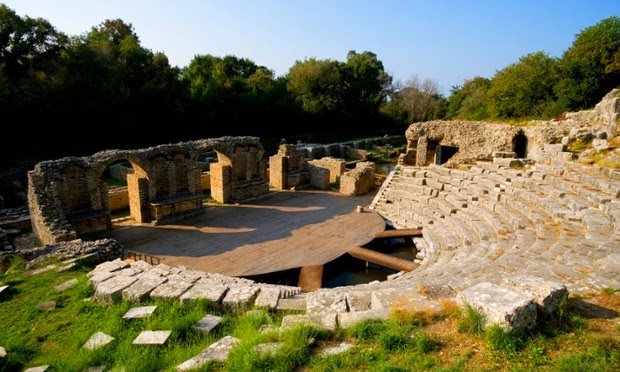
Butrint, Albania - among top 10 national parks in Europe

One of the most prestigious newspaper in Europe "The Guardian", published an article about  Top 10 national parks in Europe, based on readers and travelers tips. Butrint Park- Albania, is ranked among these top 10 national parks.

Here it is what The Guardian writes about the Butrint park:

“Very few visitors, and stunning ancient Greek, Roman, Frankish and Ottoman remains,” is what led ID4690527 to suggest the Butrint national park in Albania. In the south-west of the country, it is a must-see for fans of ancient history; it boasts a number of significant archaeological sites and is considered a “microcosm of Albanian history”.

Butrint-Albania

Here is the full article:

http://www.theguardian.com/travel/2015/apr/08/top-10-national-parks-europe-readers-travel-tips?CMP=fb_gu

26 August 2014

Family Tree of Languages, Albanian one of the oldest -New York Times

Albanian Language is among 3 oldest languages! What a great discovery! Albania is ancient, and we are proud of that. Thank New York Times for publishing the findings! 

Biologists using tools developed for drawing evolutionary family trees say that they have solved a longstanding problem in archaeology: the origin of the Indo-European family of languages. 


The family includes English and most other European languages, as well as Persian, Hindi and many others. Despite the importance of the languages, specialists have long disagreed about their origin.
Linguists believe that the first speakers of the mother tongue, known as proto-Indo-European, were chariot-driving pastoralists who burst out of their homeland on the steppes above the Black Sea about 4,000 years ago and conquered Europe and Asia. A rival theory holds that, to the contrary, the first Indo-European speakers were peaceable farmers in Anatolia, now Turkey, about 9,000 years ago, who disseminated their language by the hoe, not the sword.
The new entrant to the debate is an evolutionary biologist, Quentin Atkinson of the University of Auckland in New Zealand. He and colleagues have taken the existing vocabulary and geographical range of 103 Indo-European languages and computationally walked them back in time and place to their statistically most likely origin.
The result, they announced in Thursday’s issue of the journal Science, is that “we found decisive support for an Anatolian origin over a steppe origin.” Both the timing and the root of the tree of Indo-European languages “fit with an agricultural expansion from Anatolia beginning 8,000 to 9,500 years ago,” they report.
But despite its advanced statistical methods, their study may not convince everyone.
The researchers started with a menu of vocabulary items that are known to be resistant to linguistic change, like pronouns, parts of the body and family relations, and compared them with the inferred ancestral word in proto-Indo-European. Words that have a clear line of descent from the same ancestral word are known as cognates. Thus “mother,” “mutter” (German), “mat’ ” (Russian), “madar” (Persian), “matka” (Polish) and “mater” (Latin) are all cognates derived from the proto-Indo-European word “mehter.”
Dr. Atkinson and his colleagues then scored each set of words on the vocabulary menu for the 103 languages. In languages where the word was a cognate, the researchers assigned it a score of 1; in those where the cognate had been replaced with an unrelated word, it was scored 0. Each language could thus be represented by a string of 1’s and 0’s, and the researchers could compute the most likely family tree showing the relationships among the 103 languages.
A computer was then supplied with known dates of language splits. Romanian and other Romance languages, for instance, started to diverge from Latin after A.D. 270, when Roman troops pulled back from the Roman province of Dacia. Applying those dates to a few branches in its tree, the computer was able to estimate dates for all the rest.
The computer was also given geographical information about the present range of each language and told to work out the likeliest pathways of distribution from an origin, given the probable family tree of descent. The calculation pointed to Anatolia, particularly a lozenge-shaped area in what is now southern Turkey, as the most plausible origin — a region that had also been proposed as the origin of Indo-European by the archaeologist Colin Renfrew, in 1987, because it was the source from which agriculture spread to Europe.
Dr. Atkinson’s work has integrated a large amount of information with a computational method that has proved successful in evolutionary studies. But his results may not sway supporters of the rival theory, who believe the Indo-European languages were spread some 5,000 years later by warlike pastoralists who conquered Europe and India from the Black Sea steppe.
A key piece of their evidence is that proto-Indo-European had a vocabulary for chariots and wagons that included words for “wheel,” “axle,” “harness-pole” and “to go or convey in a vehicle.” These words have numerous descendants in the Indo-European daughter languages. So Indo-European itself cannot have fragmented into those daughter languages, historical linguists argue, before the invention of chariots and wagons, the earliest known examples of which date to 3500 B.C. This would rule out any connection between Indo-European and the spread of agriculture from Anatolia, which occurred much earlier.
“I see the wheeled-vehicle evidence as a trump card over any evolutionary tree,” said David Anthony, an archaeologist at Hartwick College who studies Indo-European origins.


http://www.nytimes.com/interactive/2012/08/24/science/0824-origins.html?smid=fb-share&_r=1&