Showing posts with label Albanian tourism. Show all posts

05 March 2020

Albania is the last secret of Europe

Albania is the last secret of Europe. Spanish travelers of a certain age remember that, for many decades, their passports indicated: " valid for all countries except for Albania, North Korea and Outer Mongolia ." To the most restless, that woke up an uncontrollable desire to discover what these forbidden countries hid. Of these banned countries, Albania was the closest, but until very recently it has remained away from the tourist map . Now Albanians want to show themselves to the world and teach their beauties, both cultural and natural. And it should be done before mass tourism discovers it.

This is how El Pais, the biggest Spanish newsletter starts its article about Albania, to recommend this unique place to all Spanish tourists. The article is recommending Albania to Spanish tourists, considering it as a "irresistible mixture of splendid beaches, dense forests and Ottoman cities where the trace of communism is still felt". The article is starting with Tirana, then with UNESCO sites, Berat, Gjirokastra, Butrint and the beautiful sandy beaches of Ksamil, Himara, the museal city of Kruja, then the experiences of other cities Korca and Shkodra.


Decades of isolation have made Albania, a somewhat smaller dimension than Catalonia or Galicia , a country different from the rest of its Balkan neighbors. It is not a destination for those looking for many comforts and a trip without unforeseen events. But perhaps there is the grace: to turn a trip into a little adventure. Thus, we will cross mountainous territories through winding roads; we will look out on a wild coast; we will walk through some towns that are like a Venetian mosaic of Byzantine churches with frescoes and naked mosques, tekke bektashíes (sanctuaries) and Ottoman houses of gleaming white, Kombinat mastodónticos (business conglomerates) of the Soviet era and tiny bunkers. But without a doubt, the most surprising discovery is its 400 kilometers of coastline where the Adriatic sand merges with the stones of the Ionian beaches..


08 January 2020

Where to go in 2020: an insiders’ guide - Albania is in the list!


Albania is listed by Financial Times as an excellent destination to visit in 2020.

“Montenegro was the star of 2019 but the whole region is on the rise,” says Jonny Bealby of Wild Frontiers, who reports bookings for 2020 up 15 per cent compared with the same point a year ago.

“Visitors are drawn to the mountains, canyons and rivers, the sparkling coastline, ancient towns, Greek and Roman ruins, Ottoman citadels and rural hospitality.”

Trekkers are finding the Accursed Mountains in the north of the country — off limits during the country’s years of communist isolationism and during the Kosovo war — offer an alternative to the Alps with almost no-tourist development.

Meanwhile, historical tours are taking growing numbers beyond the Unesco World Heritage site of Butrint to explore the numerous Roman, Byzantine and Ottoman sites throughout the country.


Read the full article here

Where to go in 2020: an insiders’ guide


By Financial times

1 Armenia

Georgia has enjoyed soaring visitor numbers, and a string of new airline routes, since it was tipped in the equivalent of this article two years ago. Visits by international tourists during the first 11 months of 2019 were up 19.4 per cent compared with the same period in 2017. Meanwhile its southern neighbour Armenia has remained relatively off the radar — attracting fewer than a quarter of Georgia’s visitor numbers — though that now seems to be on the verge of change.
Four members of our panel picked Armenia as one to watch in 2020 (Wild Frontiers says its forward bookings are up 100 per cent compared with a year go) and the country will get its first low-cost airline links with western Europe. Ryanair, Wizz and Air Baltic are all due to launch flights, connecting the capital Yerevan with cities including Milan, Rome, Berlin and Vienna. The main draw for visitors is the country’s extraordinary collection of medieval monasteries and churches, many of them set among dramatic mountains. Geghard monastery, for example, was cut into the rock of the Upper Azat valley and was completed in the 13th century. It is now a Unesco world heritage site, as are the monasteries at Haghpat and Sanahin.
But Yerevan and the wine-lands are also fascinating. “Yerevan is one of the region’s most exuberant and endearing cities,” says Justin Wateridge of Steppes Travel. “Both country and capital are an unexpected delight that you need to discover before the secret gets out.”
Tom Marchant of Black Tomato recommends the newly opened Alexander hotel in Yerevan, part of Marriott’s Luxury Collection, as well as stopping for a degustation at the Ararat Brandy Company.

2 Chad

For travellers who really want to get off the beaten track, Chad is ideal. More than five times the size of the UK, the entire country gets fewer visitors in a year than Tate Modern gets in a week. And that is despite glorious desert and mountain scenery, fascinating ancient rock art and the closest “big five” safari park to Europe.
The bad news is that there is a reason for such a dearth of visitors: the UK Foreign Office advises against “all but essential” travel to most of the country, and “all travel” to the rest, highlighting the potential risk of crime and terrorism; the US State Department suggests potential visitors “reconsider”.
Despite that, several tour operators tip it as a rising destination for the coming year, a recommendation that is largely down to the work of African Parks, a South African-based non-profit conservation organisation. In 2010 it was invited by the Chadian government to sign a long-term agreement to manage Zakouma National Park, a 1,200 sq mile park in the south-east of the country that had been ransacked by horseback-riding poaching gangs.
With the help of EU funding, African Parks restored security (elephant deaths fell from 4,000 in the eight years to 2010, to just 24 since then), opened 17 schools and created employment at the three tourist camps.
In 2017, the government put an expanded area around the park into African Parks control, then in February 2018 the organisation was given responsibility for the Ennedi Natural and Cultural Reserve, a 15,500 sq mile expanse of sandstone mountains in the north of the country, filled with dramatic canyons, cliffs and arches as well as rock art that dates back 7,000 years. “Declared a World Heritage Site in 2016, the Ennedi is a vast wilderness with a savage beauty,” says Will Jones of Journeys By Design.

3  UK

Britain may be preparing to leave the EU, but the British national tourism agency is predicting a record year in 2020. Visit Britain says international tourist numbers will hit 39.7m, the highest ever and almost 5 per cent up on 2018. Particularly important to the growth are emerging tourism markets in the east — Visit Britain’s data shows flight bookings to the UK for the first half of the year are up 33 per cent from China, and 22 per cent from south Asia. 
While the reduced value of sterling has helped make the UK cheaper, the big draw this year is likely to be the country’s literary and artistic heritage. 2020 is the 250th anniversary of William Wordsworth’s birth (marked by a £6.2m project to expand the museum at his former home, Dove Cottage at Grasmere in the Lake District) and the 150th anniversary of Charles Dicken’s death (with a five-day festival in Rochester among many others). Meanwhile the lack of a significant anniversary does not seem to have deterred Jane Austen fans: a 10-day festival is planned in Bath in September, there is a nine-day festival in Hampshire in June, and yet another film version of Emma is due for release in February, starring Anya Taylor-Joy and a string of fabulous stately homes.

4 Norway

A growing awareness of climate change has brought the Arctic regions to the forefront of many minds. On one hand, the vulnerability of the ice caps, wildlife and traditional ways of life inspires an increasingly emotional reaction — the endangered glaciers pitied in the same way as the elephants and rhinos of east Africa. On the other, in a warming world, spending a summer holiday somewhere cold rather than hot seems increasingly attractive.
Above all, the Arctic has become so much more visible: consider, for example, that in 48 hours over Christmas, the BBC’s output included radio broadcasts from Greenland and Iceland, a two-hour “slow TV” programme following a Sami sleigh ride through Arctic Norway, and a film about the disappearing skills of the Inuit, “an elegy to the world that is melting away”.
Even Hollywood is leveraging the appeal of the north: Disney’s new children’s movie Frozen 2 draws heavily on Sami culture, myths and landscapes while the forthcoming James Bond movie No Time to Die, out in April, includes snowy sequences filmed in Norway.
While countries across the north are experiencing growing visitor numbers, Norway is especially well placed to benefit, with infrastructure that makes it straightforward to reach the Arctic, and an abundance of fjords, mountains and islands. Set among them are a growing number of landmark architectural projects by the Oslo-based practice Snohetta, a master at creating buildings that manage to be both appropriate to the stark beauty of their surroundings as well as catnip for social media.
Among them are Europe’s first underwater restaurant, launched in March 2019, the National Opera house in Oslo, a remote pavilion for watching passing reindeer at Hjerkinn, and the forthcoming Svart, a circular hotel just above the Arctic Circle, which isn’t due to open until 2022 but is already generating a buzz.
“Interest in all things Nordic continues to grow,” says Georgina Hancock at Discover the World, who tips Senja Island, to the west of Tromso, as “a quieter, under-explored alternative to the well-trodden Lofoten Islands”.
At Red Savannah, George Morgan-Grenville reports forward bookings for Norway up 33 per cent compared with this point a year ago. Both agree about the appeal of Svalbard, which in 2020 marks 100 years of Norwegian sovereignty, and offers the chance to visit the world’s northernmost city, school, museum, piano and much more. “Nowhere is more wild,” says Morgan-Grenville.


5 Turkey

Tourism in Turkey collapsed in 2015 and 2016 in response to terrorist attacks and political instability, with visitor numbers falling almost 40 per cent. Those security fears have now eased, and tourist numbers are rebounding — helped by a significant devaluation of the lira (a euro currently buys about 6.6 Turkish lira, up from about 2 lira a decade ago).
That exchange rate has made citybreaks more affordable in Istanbul, with its constantly expanding roster of luxury hotels. Recent additions include Sofitel on Taksim square, which opened in November complete with 33 Hermés-designed suites) and the Six Senses Kocataş Mansions, which soft-launched the same month, housed in two 19th-century mansions and with far-reaching views over the Bosphorus. The longer term trend, however, is for adventure-seeking tourists to look beyond Istanbul and the Mediterranean seaside resorts. Steppes highlight the move of the World Nomad Games this year from a remote yurt village in Kyrgyzstan to the Turkish city of Bursa, making it far easier for international visitors to watch events including kok-boru, a sort of central Asian equivalent of rugby, with competitors on horseback and a headless goat in place of a ball (the date for the event has yet to be announced).  
In the far east, the ancient archaeological sites of Upper Mesopotamia are attracting growing interest, with numerous operators offering expert-led group tours. Meanwhile skiers in search of perfect powder and a complete absence of crowds are travelling to Turkey Heliski’s base in Ayder, close to the south-eastern shore of the Black Sea, where visitors this winter are expected to include the star Swiss free-rider Sam Anthamatten.

6 Japan

Data from eDreams ODIGEO, which claims to be Europe’s biggest online travel agency, suggests a surge in the number of European travellers heading to Tokyo in 2020. Across its various websites, forward bookings are up 90 per cent compared with the same period a year ago. There is one obvious reason: the Olympics and Paralympics, due to take place in late July and early August. Some estimates suggest the Games might attract an additional 10m visitors, and there has been a rush of hotel openings in expectation.
Tourism in the country is already soaring: 31.2m foreign travellers visited in 2018, up from 8.6m in 2010. In 2016 the government set a target of reaching 40m visitors by 2020, and 60m by 2030. The downside has been the concentration of visitors in the honeypot sites of Tokyo, Kyoto and Osaka, something the national tourist office has tried to counter with publicity campaigns promoting lesser-known regions, and which should be helped by new flight routes including, for example, Finnair’s direct service to Sapporo, on the northern island of Hokkaido, which launched last month.
“Quite apart from the Olympics, Japan is increasingly on the radar of those seeking alternative, experiential travel and a completely unhomogenised cultural identity,” says George Morgan-Grenville of Red Savannah. He suggests 2020 hotspots will include the Samurai districts of Kanazawa, the scenic coastline of Noto, and the art museums of Naoshima Island.

7 Uruguay

“Uruguay has always been considered a seasonal destination, but is just as special outside the December/January rush,” says Harry Hastings of Plan South America. “It’s ideal for ‘slow travel’, with cycling and riding trips through olive groves, vineyards, fishing villages and the open farmland of the south, stopping for sea swims, picnics, wine tasting and visits to artists’ studios.”
Home to fewer than 3.5m people, the country has long been in the shadow of its neighbours, Brazil and Argentina, with only the sceney seaside resorts of Punta del Este and José Ignacio attracting much international attention, and even then only in summer.
Now, though, small numbers of visitors are beginning to look beyond those hotspots, to the remote beaches of Rocha state, the surfer hang-out of La Pedrera, the old Portuguese city of Colonia del Sacramento and sleepy Carmelo, surrounded by vineyards, wineries and tasting rooms and known by some as South America’s answer to Tuscany.
Visitors should explore rich, full-bodied reds made with Tannat grapes, produced from vines descended from cuttings across the Atlantic in the 19th century before phylloxera devastated the originals in southern France.
The journey I’m really excited about next summer is a road trip from Alaska to California. I’ll be in Alaska in August giving a talk on board the QE2 and I’ve given myself a couple of weeks in between jobs to travel down the west coast of Canada and the US to San Francisco before I head to the Burning Man festival with some friends.
I’ve been to California before, but never seen the rest of the west coast so I’m looking forward to exploring, particularly Oregon and the Rockies and seeing Mount Washington in the flesh, spotting bears and experiencing some real wilderness.

8 Dominica
The mountainous Caribbean island has staged a remarkable recovery from the devastation of Hurricane Maria in 2017, while promotional campaigns billing it as “the nature island” seem more in tune with the times than some of its glitzier neighbors.
Rather than white sands and smart restaurants, the draw here is the pristine rainforests, remote mountain gorges and waterfalls. The tourist board is keen to distinguish it as a place for adventure travellers and in particular as a place for hiking: the country is home to the longest walking route in the Caribbean, the 185km Waitukubuli trail and a system of free “hike passports” was introduced in 2019 for visitors to record their walks.
The government has been working to restore trails damaged in the hurricane, while also introducing a string of environmental policies (plastic straws and cutlery were banned last year; plastic bags are due to be banned outright in 2020).
While eco-tourism remains the focus, the accommodation options are moving increasingly upmarket. Secret Bay, a glorious clifftop retreat that closed when the hurricane struck, reopened in November 2018 with major upgrades. It now comprises six villas built from sustainably sourced tropical hardwood, each of which has a private plunge pool and sea-views from the covered terraces.
The Kempinski group’s Cabrits Resort, a five-star beach hotel surrounded by the tropical forest of Cabrits National Park, opened in October 2019 while the Anichi Resort, part of Marriott’s Autograph collection, is due to open in 2020.

9 Albania

“Montenegro was the star of 2019 but the whole region is on the rise,” says Jonny Bealby of Wild Frontiers, who reports bookings for 2020 up 15 per cent compared with the same point a year ago. “Visitors are drawn to the mountains, canyons and rivers, the sparkling coastline, ancient towns, Greek and Roman ruins, Ottoman citadels and rural hospitality.”
Trekkers are finding the Accursed Mountains in the north of the country — off limits during the country’s years of communist isolationism and during the Kosovo war — offer an alternative to the Alps with almost no-tourist development. 
Meanwhile, historical tours are taking growing numbers beyond the Unesco World Heritage site of Butrint to explore the numerous Roman, Byzantine and Ottoman sites throughout the country.
And, on a totally different note, the Kala music festival, a week-long seaside party on the southern coast at Dhërmi, is putting Albania on the map for young travellers, in the same way events such as the Garden, Outlook and Sonus festivals did for Croatia. It is a measure of the Albanian authorities’ enthusiasm for tourism that prime minister Edi Rama attended the first Kala festival in 2018. “People think of it as a place where you get robbed or killed,” Rama told a poolside press conference, The Guardian reported. “But the stigma has helped us. When someone visits and gets out alive, they realise it’s paradise!” The figures appear to back him up: foreign visitor numbers for the first 11 months of 2019 topped 6.1m, up 8.3 per cent on the same period in 2018, and up from 1.9m for the full year of 2009.

Read more >>> Financial Times   

20 October 2017

Suitcase magazine: Why Albania needs to be your next European escape

Why Albania needs to be your next European escape-  this is the title of the article published by Suitcase travel magazine.  This media known for quality of the writing about tourism destinations is suggesting its readers  to visit Albania, a country full of surprises.
Lottie Gross is the author of the article, a contributor in several travel magazines and this is not the first time that she writes for Albania. “When you think sun, sea and sand, Albania certainly isn’t the first destination that comes to mind. Well, think again. Pack up your preconceptions and discover a country full of intrigue; its architecture, language and history weave together to create a cultural fabric unlike any other European destination.
Photo source: Suitcase
It’s ripe for exploration and here’s why:
  1. There’s an entire coastline of gorgeous, deserted beaches
  2. There’s a fascinating recent history most people know little about
  3. You can go even further back in time in old Ottoman towns
  4. You can take one of the world’s most beautiful boat trips
  5. There’s food for all palates

Photo source: Suitcase
Albania is home to some of the Mediterranean’s most pristine and unadulterated beaches. As the country sits sandwiched between Greece and Montenegro, soft sandy shores and warm waters tickle its entire western side.
A coastline so sparkling should be overrun with international visitors sunning themselves on the sands, but instead it’s the locals (and a few Germans and Norwegians in certain spots) that enjoy these relatively quiet shores.
Beyond the beaches and the capital, Albania’s countryside is peppered with charming towns and cities that are such a pleasure to explore it’s near impossible to leave them behind.
Gjirokastra, home of the revered author Ismail Kadare, clings to a hillside in the central part of the country, south of Tirana. Tall, Ottoman-style houses, built mostly in the 19th century, stand to attention on the steep, winding cobbled streets. A few hours north of Gjirokastra, the hilltop town of Berat is perhaps the country’s most atmospheric. Housed within the walls of an old citadel, Kalasa, at the top of a seriously steep slope, this ancient maze of streets is still home to hundreds.
In the far north a Valbona is one of the most beautiful places in Albania. Tucked amongst the Dinaric Alps, the mountains strike up from the floor like shards of broken glass and the river runs a perfect cyan through its centre.
Photo source: Suitcase

Albanian food cobbles together some of the best bits of Turkish, Italian and Slavic cuisine. Everyday staples include qoftë (pronounced chof-tuh), a grilled minced lamb sausage, spit-roasted lamb kebabs and kos (yoghurt).

12 July 2016

Business Insider: There is no better time to visit Albania than now

Locked between dramatic mountain faces and azure blue seas; it’s nothing short of a miracle that Albania hasn’t made it onto the mainstream tourist trail yet.
“Shqipëria” to the locals, it’s known to its natives as the land of the eagles, a moniker adopted from folklore tales passed down from generation to generation. They tell of how a young Albanian saved an eaglet from certain death at the fangs of a venomous snake. And it’s that willingness to do things for others that sums up the spirit of the country.
Albanians are known for their hospitality, kindness, and affinity for knocking back glasses of homemade Raki. The days of communist dictatorship are a distant memory for all but a few. Albania is looking ahead to a brighter future. There is no better time to visit than now. 
The author of article, the blogger Tiny Rucksack suggest 5 places in Albania that everyone should visit. Here they are:
                                BERAT
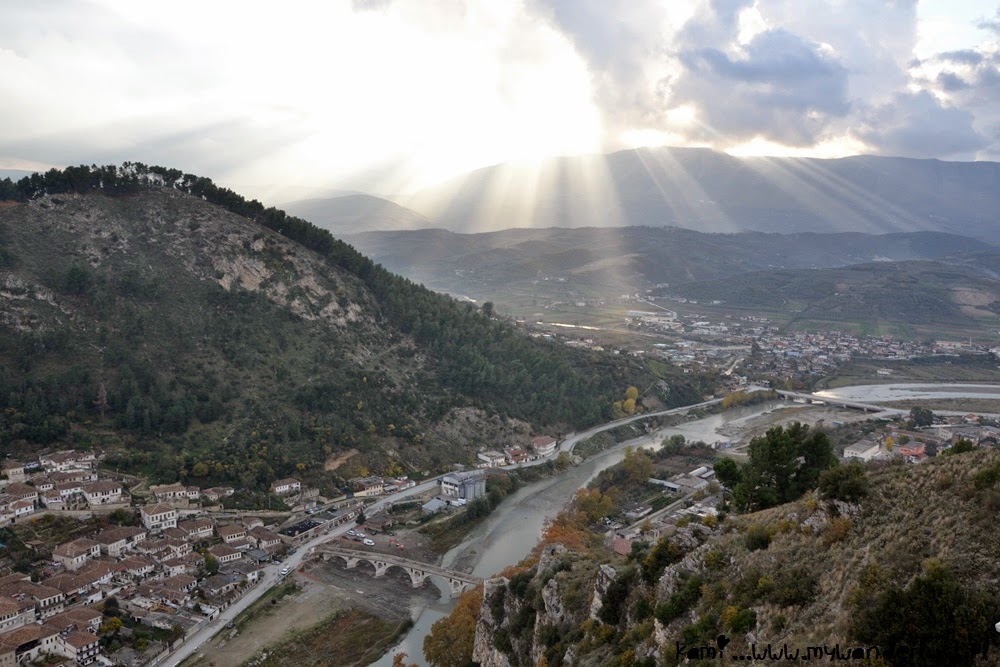
Tucked between the Tomorr mountain (which locals claim to be the resting body of a fallen giant) and the Osum river, Berat is the jewel in the crown of Albania. Home to 60,000 people, many of whom tell tales of being forced to work in the munitions tunnels carved by the Communist government into nearby hills. It’s a town of two halves – the winding medieval white-washed streets cut a course on the right bank of the river, while an altogether more modern settlement is the hub of the town on the left bank.
High above the town lies its castle – a fortress built to protect the town and her inhabitants from Byzantine raiders. Once it was a front line of wars between powerful empires vying for control. Now a slippery marble paved road keeps all but the most determined flip-flop clad tourists from reaching the top.Consecutive invasions of Berat have left the town with a mixture of architecture. The Turks brought their influence, as did the Communists. An interesting mish-mash of styles pleasing to the eye, and the camera.

                    Valbona National Park
Misty mountains and alpine streams dominate in this untouched corner of europe’s unexplored country. The traditional way of life is slowly changing in the steep-sided valleys. Farmers are turning their hand to hosting trekkers looking for adventure.
The region borders Kosovo, territory fiercely claimed by both Serbs and ethnic Albanians. It’s home to wild dog,  wolves, and some say bears. But don’t let this put you off. The mountains offer fantastic trekking, climbing and camping.

Albania is becoming a stoic pinpoint on the map for travellers from around the globe. New roads are being built, hotels are under construction, and the country is planning to build a second airport, at Kukës – development which’ll make getting to northern Albania much easier, and visiting a more attractive prospect.

                The “not to be missed” Lake Koman ferry
A ride along Lake Koman is only comparable to a trip on the Norwegian fjords. Bottle green trees meet the waters edge along the breathtaking route.  The landlocked lake through the ‘accursed mountains’ is actually a hydro-electric damn, but also forms part of an ancient route from Kosovo to Albania. The rickety ferry stutters into life several times a day, passing which scenery has to be seen to be believed.
photographers dream, the landscape could have been plucked from the Lord of the Rings trilogy. Mountains tower above the lake as it weaves its way to Fierza. It’s a route used by tourists and locals alike – meaning it’s a great chance to practice pigeon Albanian (or sit back, have a beer and take in the views). 
Lake Koman is the most scenic route to travel to the Valbona National Park from Shkodër. It has been described as “one of the world’s great boat trips”.

                                              Himarë
This sleepy fishing village on facing out toward the Ionian Sea remains relatively untouched by Aussie backpackers flaunting flip-flops and tales of far-flung lands. Sea food restaurants line the sea front enjoying unspoilt views over the town’s beach.
 Less than half an hour’s stroll away from the Xhiro is ‘Albania’s Ibiza’ – Jala. Toned men and bikini-clad women descend on the beach to drink at its bars, swim in crystal clear waters and ‘be seen’ during the summer month. It’s a world away from the serenity of the surrounding villages.
Reminders of Albania’s communist dictatorship past are ever present.  On a clear day the Greek island of Corfu is visible – too visible for those once in Tirana’s corridors of power awaiting an imminent invasion which never came. The now defunct fortifications line the roads leading between the coastal towns and villages.

                                         Tirana – the capital city
Probably Europe’s weirdest capital city. At first glance Tirana doesn’t have a huge amount to offer a wondering soul, but its quirkiness makes it worth at least a day stop-off. The International Center of Culture (or the Pyramid of Tirana) tops the Albania’s list of the weird and wonderful. Opened in October 1988 was intended to be a museum to Enver Hoxha – the leader of Albania’s communist cult. The pyramid new sits empty and derelict. It’s an ad hoc climbing frame for plucky locals and tourists hoping to get that “perfect selfie”.
Tirana of the centre of Albanian life. Smartly dressed men and women weave their way between the chaotic traffic like in any other European capital. It’s the home of the country’s night life, especially the Blokku area, a section of town formerly reserved for the country’s elite.


Read article here: 

06 January 2016

The Rough Guide: Albania, among top 10 destinations for 2016

Albania is definitely on the map of World Tourism. One of the best travel agencies The Rough Guide also suggest our country as one of top 10 destinations for 2016. Albania is ranked number 5, after Nepal, Colombia, Cuba and Jordan, and followed by Romania, El Salvador, Wales, Kenya and Sri Lanka.  Here is what Rough Guide writes about Albania.
 
5- Albania 

"Pay a visit to this beguiling corner of Europe now, before it garners the popularity it deserves. – Martin Zatko, co-author of The Rough Guide to Europe on a Budget
 
While nearby Greece and Croatia are well established on the tourist trail, Albania remains something of a mystery to most. But those who go will find fascinating UNESCO World Heritage sites such as the ancient Greek city of Butrint, pristine beaches on the Ionian coast, gorgeous mountain lakes, Ottoman architecture, and friendly locals to point you in the right direction for discovery. Make the trip before the rest of the world realises what they’re missing.

08 December 2015

L’Albanie parmi le top 5 des destinations pour 2016 via Le Figaro

L’Albanie susciter l'intérêt dès les médias françaises. Le Quotidien français, Le Figaro, le deuxième plus grand journal national en France a placé l’Albanie parmi les 5 places d’être visitée en 2016.

4. L'Albanie

"Surprise du classement, mais également en football, avec une récente qualification pour l'Euro 2016. Avec plus de 10% d'augmentation des recherches des départs vers l'Albanie de 2014 à 2015, cette destination pourrait bien voir son tourisme se développer en 2016. Entre parcs nationaux et plages à couper le souffle, c'est un pays qui a beaucoup à offrir.

À voir en Albanie: la mosquée Ethem Bey de Tirana, avec sa voûte colorée. Se balader dans les petites rues au style ottoman de Gjirokastër, la «ville aux mille marches» à flanc de montagne. Les ruines antiques et byzantines de la cité d'Apollonia, sur la côte albanaise."
Shkodra Castle


Cliquez ici pour l'article:

http://www.lefigaro.fr/voyages/2015/12/07/30003-20151207ARTFIG00288-le-top-5-des-destinations-pour-2016.php

25 February 2015

Impressions from Albania

Albania is continually  impressing tourists coming from all over the world, especially those who come for the first time. A Polish tourist is describing our country with such heartfelt words. She is amazed by the beauty of Albania: landscape, towns, people and food. Thank you Kami.
Enjoy her article!

Impressions from Albania
By Kami and the rest of the world

"Albania is the country I knew next to nothing about prior to my visit. I have included Albania in the itinerary, even if just for two days. And it was the best decision ever! From the very first moment I opened my eyes in the bus somewhere in the middle of Albania I knew I’m going to enjoy it. It looked messy, chaotic and so beautiful! .. Dramatic mountains, deep valleys and picturesque towns – that’s what I’ve seen in Albania.. Albania joined the club and ranks pretty high in my personal list of the countries with best people...  It’s been locked for years, making it almost impossible to learn more about it but fortunately it’s slowly opening to the world. The tourism is growing, Albania is discovered by more people and I’m sure in few years’ time it will be a really big thing! So make sure to get there before everyone else will! ....."

Read the full article here:
http://www.mywanderlust.pl/impressions-from-albania/


15 June 2012

"Albania" - We can do it !

Just heard from the media about this wonderful project of Elisa Dushku. This is probably the first initiative of this kind in promoting Albania, even though it is a common thing in promoting destinations all over the world to attract the attention of tourists and investors to visit a country. Greece had a similar campaign few weeks ago which ended with success and reached its target.

I believe that we Albanians can also show that we can do it. I don’t think our Elisa Dushku, Fadil Berisha and the rest of the team are not able to find 60 000 $ to support this promotion campaign, but this should come as support of as many Albanians as possible, because this country belongs to all Albanians and needs our support. So please donate as much as you can!
Especially at this moment when Albania and its tourism is getting the attention from the well known media such as LonelyPlanet, CNN, Frommer's etc. this can be the best promotion material to keep the beat going. The entire Albanian travel industry will profit from this, which means better image for Albania and more money for our economy.
We can and should make it! I believe this can be the best promotion gift Albania tourism can get in its 100th Independence anniversary.
Kliton Gerxhani
Albania Holidays DMC


16 April 2012

The Observer: Testing the water in Albania - by Killian Fox, Sunday 15 April 2012

Thank you for this nice article about visiting the Albanian Alps. These two quotes of yours say it all about the beauty of Albania and the genuineness of Albanian tourism:
“Anywhere else in Europe, this two-hour journey (which our guide book describes as "one of the world's great boat trips") would be hopping with tourists, but Albania is not a big draw – at least not yet” and “Ask someone on the street and, even if they can't help, they'll find someone whose second cousin definitely can. If helpfulness and hospitality were a marketable resource, Albania would be rich.”
You can book the accommodation in Valbona also through our website Albania Hotel
Below the article:
Staggering scenery, deserted landscapes – crossing Lake Koman in northern Albania provides an insight into a country that's still off the tourist radar
The surface of the lake is perfectly still. The steep hills on either side and the high mountains beyond are empty of human life, save for the occasional lonely farmstead
embedded in the hillside. There are no visible roads, no telephone wires to connect this place to the outside world. It's not difficult, on the ferry journey along Lake Koman in northern Albania, to imagine you're drifting through a landscape that has lain undisturbed for centuries.
It's the height of summer but there aren't many people on the ferry either. Most of our fellow passengers on this hulking cargo ship are down below, smoking and drinking
lethally strong coffee in the bar. They've seen it all before. Those who haven't – my girlfriend and I, a few backpackers and some tough-looking Czech bikers – are on the upper deck drinking in the staggering scenery.
Anywhere else in Europe, this two-hour journey (which our guide book describes as "one of the world's great boat trips") would be hopping with tourists, but Albania is not a big draw – at least not yet. The last century has been hard on this little country, just across the sea from Italy and just north of Greece. More than 40 years of communist rule under the isolationist dictator Enver Hoxha, followed by a ruinous period of extreme capitalism in the mid-90s, have left the country struggling to find its feet in the new millennium.
Our first port of call had been Shkodër, the largest city in the north, overlooked by an impressive medieval castle built by Venetians and Ottomans, and crisscrossed by wide
communist-era boulevards. When its population emerges in the evening to promenade and gather outside cafés, you could imagine you were somewhere in Italy – until you hear a muezzin's call from one of the city's many mosques, or fix your eye on a building that looks like it was transplanted from 1950s Moscow.
We planned to strike out the next morning for the Albanian Alps in the north-east. The best way to get there, if you want to avoid a long, precarious road journey, is by the Lake
Koman ferry. But we had no idea how to get to the lake, couldn't find an information
office, and even the guidebook was sketchy on the subject. Eventually a taxi driver with a few words of English called a friend and arranged for us to be picked up early the next morning. This was typical of our experience. Ask someone on the street and, even if they can't help, they'll find someone whose second cousin definitely can. If helpfulness and hospitality were a marketable resource, Albania would be rich.
It was 6.30am when George, a cheerful man with a thick moustache, ushered us into his minivan outside the Rozafa Hotel. At 6.32am, we drew up alongside a café on the same
street and George treated us to early-morning espressos accompanied by shots of Metaxa brandy. At 7.15am, we were finally good to go.
Lake Koman was created by a dam – a major hydroelectric project built in the 1980s. An hour into the ferry journey, the tree-lined hills give way to sheer limestone cliffs which
gradually close in until it looks like you've run out of lake. Just as you conclude you're heading straight into the side of a mountain, the water opens up again and you turn into a narrow passageway between two vertical walls of rock. It's like the riverboat sequence in the first Lord of the Rings movie. Even the Czech bikers were gaping.
The Valbona valley, at the heart of the Albanian Alps, is a two-hour drive from the ferry's Fierzë terminus. It's flanked on each side by high mountains. The elevation was so
dramatic that we had to crane our necks to see their craggy peaks.
We spent several nights at a friendly little chalet-style hotel called Rilindja, hiking around
the local villages and eating fresh river trout. And yet we'd seen only a fraction of what the country has to offer during our 10 days here. We missed out on the fine beaches (it has a coastline that bridges two seas – the Adriatic and the Ionian), the Greek and Roman ruins at Butrint, the town of Gjirokastra (Nobel laureate Ismail Kadare, who was born there, describes it as "the steepest city in the world … unbelievable [and] dreamlike"), not
to mention the capital city, Tirana. If you're willing to put up with bumpy roads and idiosyncratic transport arrangements, Albania is a rare find.